
FormWren
Pre-release docs

Start with the core object

First Five Minutes: Core Object First

From Unity's main menu, choose Tools > Rounded Rectangle > Create > Rounded Rectangle.

  1. Select the new object and press F to frame it in Scene view.
  2. Confirm that the generated mesh is visible.
  3. Edit it directly in Scene view: drag one resize handle, then one corner-radius handle.
  4. After the shape responds, choose whether to keep it as a world mesh or move it to Canvas mesh UI or Canvas SDF.
The new object is already a usable world mesh. It includes RoundedRectangleGenerator, MeshFilter, MeshRenderer, and a package-managed material. Optional 3D collider generation is off by default.
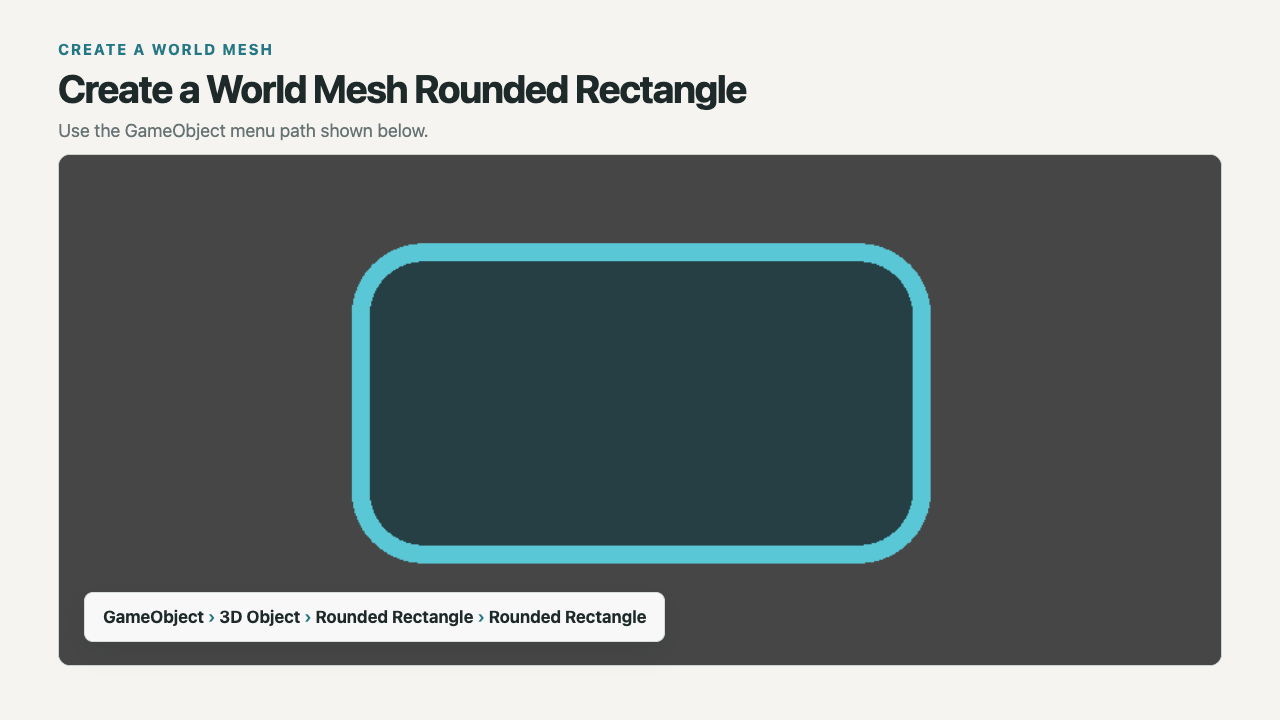
A newly created World Mesh Rounded Rectangle selected in Unity Scene view beside its creation menu route.
A visible selected mesh is the first successful result. Canvas conversion is optional and comes afterward.

Edit in context

Edit with Scene Handles and Inspector Values

Select the core Rounded Rectangle object to reveal its custom Scene view handles. Use them to shape the result where it appears; use the Inspector when you need exact, repeatable values.

  1. Drag the short edge handle to resize around the current center. Drag the long edge handle to resize and reposition while the opposite edge stays fixed.
  2. Drag a corner-resize handle to change width and height together while the opposite corner stays fixed.
  3. Drag a radius handle to change the silhouette. Locked corners share one radius; unlock a corner when it needs an independent value.
  4. Drag a border handle to set or change its thickness. At zero width, one handle remains on the relevant edge so you can create the border directly.
Scene view handles
Fast, in-context editing for size, corner radius, corner locks, and border width.
Inspector
Exact dimensions, corner profiles, stroke alignment, colors, gradients, textures, and mesh detail.
Handles not visible? Select the GameObject with RoundedRectangleGenerator, then use the Scene Handles quick row under Size & Radius. Border handles remain available when Border Width is zero.

After moving the object to Canvas, a RectTransform owns its width and height; the generator still owns the radius, border, and base style.

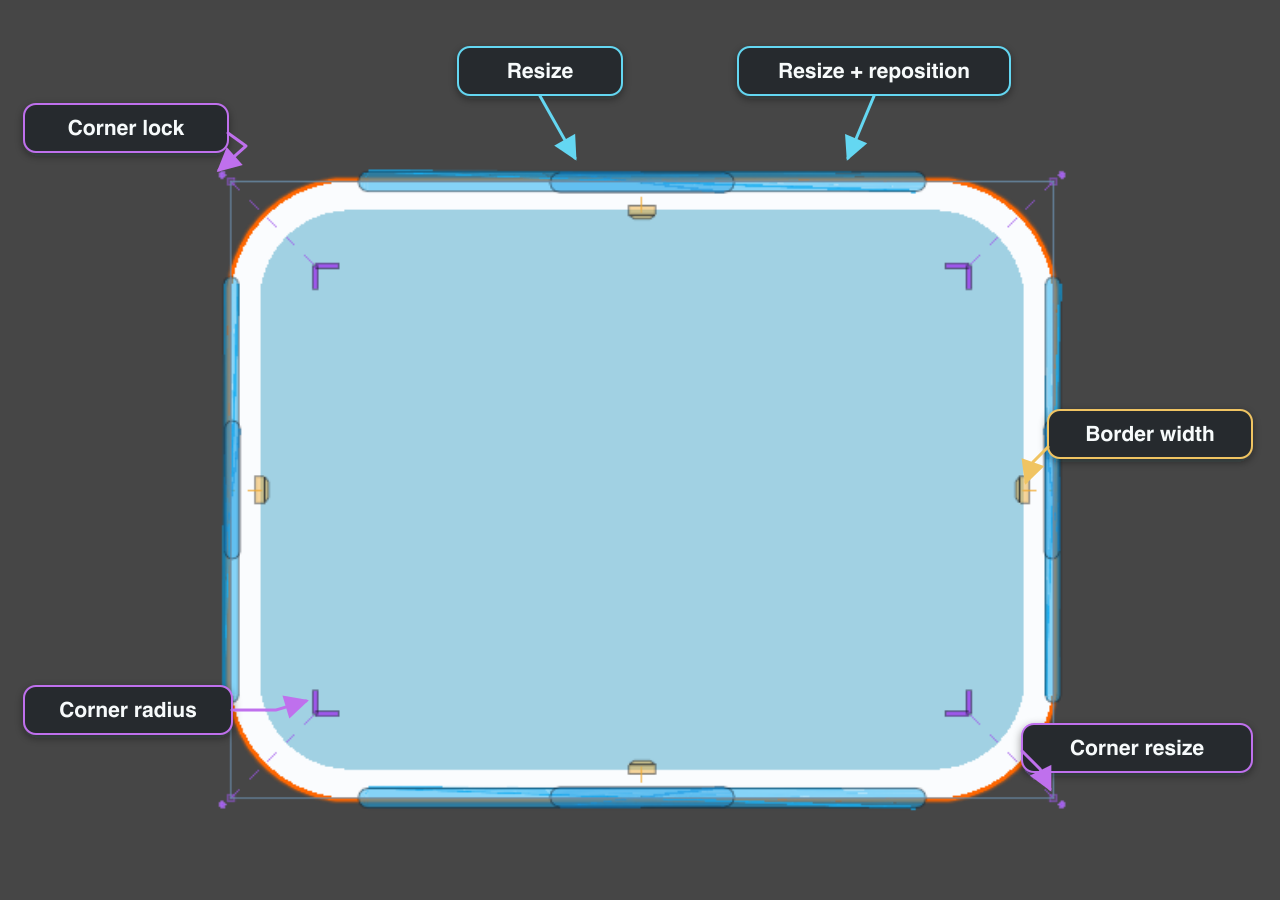
A selected pastel-blue Rounded Rectangle with labeled resize, resize-and-reposition, corner-resize, corner-radius, corner-lock, and border-width Scene handles.
The image identifies one representative of each handle role. Resize keeps the center fixed; Resize + reposition keeps the opposite edge fixed; Corner resize keeps the opposite corner fixed. The remaining controls edit radius, lock state, and border width.

Choose one destination

Choose Where It Goes Next

GoalUseFirst object
Scene object, world-space UI, AR/VR panel, inspectable geometry, or 3D collisionWorld meshKeep the object created by Tools > Rounded Rectangle > Create > Rounded Rectangle.
Generated mesh shape inside a Unity CanvasCanvas mesh UISelect the core object, then use Tools > Rounded Rectangle > Rendering Path > Move Selected to Canvas Mesh UI.
Canvas card, button, badge, or HUD panel that needs soft edges, shadow, glow, emboss, or rounded maskingCanvas SDFSelect the core object, then use Tools > Rounded Rectangle > Rendering Path > Move Selected to Canvas SDF.

Render cache, masking, and SDF export are adjunct workflows after a base destination is chosen; they are not additional rendering destinations. Continue to Rendering Paths: Adjunct Workflows when one is required.

Direct Scene use

Keep It As A World Mesh

Use this path when the rounded rectangle belongs directly in the Scene view, world space, AR/VR space, or a 3D collision setup.

  1. Keep the core object you already shaped in Scene view; no conversion is required.
  2. Keep the package-managed material while learning. Fill, border, gradient, and texture alpha work without a separate transparency-enable step.
  3. Enable Auto Update Mesh Collider if you need 3D collision. It is off by default so purely visual objects do not create or recook physics geometry.

Transparent world objects still follow Unity transparent sorting rules. The generated collider is a 3D MeshCollider, not a Collider2D.

Generated geometry in UI

Move It To Canvas Mesh UI

Use Canvas mesh UI when you want the generated mesh shape to render inside a Unity Canvas.

  1. Select a GameObject with RoundedRectangleGenerator.
  2. Choose Tools > Rounded Rectangle > Rendering Path > Move Selected to Canvas Mesh UI.
  3. The Generator Inspector's UI > Move to Canvas > Mesh UI command is the contextual alias.
Canvas
            Rounded Rectangle Mesh UI object
              RectTransform
              RoundedRectangleGenerator
              MeshFilter
              RoundedRectCanvasGraphic

Effect-based 2D Canvas rendering

Move It To Canvas SDF

Use Canvas SDF when the Canvas result needs soft edges or SDF effects such as shadow, glow, emboss, or rounded masking.

  1. Select the core Rounded Rectangle object shaped earlier.
  2. From Unity's main menu, choose Tools > Rounded Rectangle > Rendering Path > Move Selected to Canvas SDF.
  3. Continue with the same GameObject, now parented under the Canvas.
  4. Set its RectTransform to about 300 x 160.
  5. Edit shared shape and base style on RoundedRectangleGenerator; edit soft effects on RoundedRectSDFGraphic.

The Generator Inspector's UI > Move to Canvas > SDF command is the contextual alias.

Canvas
            Rounded Rectangle UI object
              RectTransform
              RoundedRectangleGenerator
              RoundedRectSDFGraphic

Recover by visible result

If You Do Not See It

World mesh
Confirm RoundedRectangleGenerator, MeshFilter, and MeshRenderer. Press F in Scene view and set a high-contrast fill.
Canvas SDF
Select the object under Canvas with RectTransform, generator, and RoundedRectSDFGraphic. Check size, material, and cache.
Canvas mesh UI
Confirm the visible Canvas object has RoundedRectCanvasGraphic and that you are not editing a leftover world renderer.
Pink material
On RoundedRectSDFGraphic, open Material > Details and use Restore Automatic Material. If it remains pink, check the pipeline and package templates in Troubleshooting.

For the full recovery path, open Troubleshooting.